
Introduction
Mango, often called the “King of Fruits,” is one of India’s most loved and commercially important fruits. Known for its delicious taste, rich aroma, and nutritional benefits, mango farming is a profitable agricultural venture for farmers, investors, and agri-entrepreneurs.
At Udhay Groups, we aim to empower farmers with practical knowledge to help them achieve high-quality yields and sustainable profits. This Mango Farming Guide will walk you through every step – from land preparation to harvesting and marketing.
1. Understanding Mango Farming
Mango farming in India is centuries old and has evolved with better techniques, hybrid varieties, and market demands. Whether you are starting on a small scale or investing in a large mango orchard, understanding the basics is essential.
Benefits of Mango Farming:
- Long-term returns with trees producing fruits for decades.
- High market demand in both domestic and export markets.
- Suitable for diverse climates in India.
- Value-added opportunities: mango pulp, pickles, juice, dried mango, etc.
2. Best Climate and Soil for Mango Farming
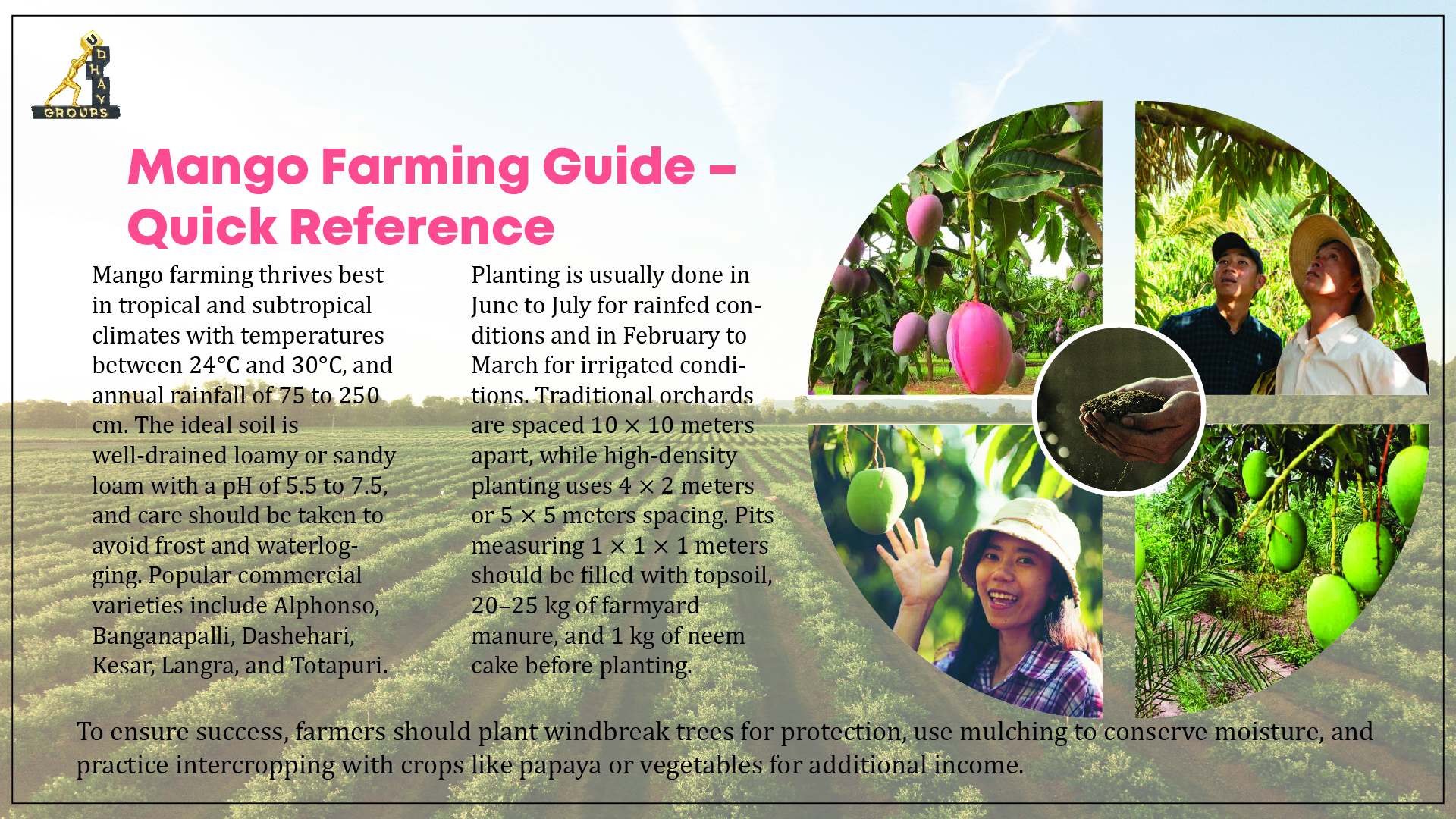
Mango trees grow best in tropical and subtropical climates.
Climate Requirements:
- Ideal Temperature: 24°C to 30°C.
- Rainfall: 75–375 cm annually.
- Dry season before flowering improves fruit quality.
Soil Requirements:
- Well-drained loamy soil is ideal.
- pH level: 5.5 to 7.5.
- Avoid waterlogged areas.
3. Choosing the Right Mango Varieties
India is home to hundreds of mango varieties. Popular commercial types include:
- Alphonso (Hapus) – Famous for its sweetness and export demand.
- Banganapalli – Long shelf life, large fruits.
- Kesar – Known for vibrant color and rich aroma.
- Totapuri – Excellent for pulp production.
- Neelum – Late-season variety with good yield.
Tip: Choose varieties based on climate, market demand, and harvesting season.
4. Land Preparation
- Clear the land of weeds and stones.
- Deep plough to improve aeration.
- Dig pits of 1m x 1m x 1m size at a spacing of 8–10 meters.
- Fill pits with a mix of topsoil, farmyard manure (20–25 kg), and neem cake.
5. Planting Mango Trees
- Best planting season: July–August (monsoon) or February–March in irrigated areas.
- Use healthy grafted plants from certified nurseries.
- Plant the graft so that the graft union remains above the soil level.
6. Irrigation Management
Young mango plants need regular watering for root establishment.
- First 2 years: Water once every 7–10 days in summer.
- Mature trees: Water during flowering and fruit development.
- Avoid excessive irrigation during ripening to prevent fruit splitting.
7. Pruning and Training
- Remove weak, diseased, and crossing branches.
- Maintain a strong central leader for better tree shape.
- Prune after harvest to encourage new growth.
8. Fertilizer and Nutrient Management
Nutrient application depends on the age of the tree:
- 1–3 years: 5–10 kg FYM + NPK (100:50:50 g/tree/year).
- 4–6 years: 20–30 kg FYM + NPK (500:250:250 g/tree/year).
- 7+ years: 50 kg FYM + NPK (1 kg:500 g:1 kg/tree/year).
- Apply micronutrients like zinc and boron to improve fruit quality.
9. Pest and Disease Control
Common Pests:
- Mango hopper
- Mealy bug
- Fruit fly
Common Diseases:
- Powdery mildew
- Anthracnose
Prevention:
- Use organic pesticides where possible.
- Spray neem oil or bio-control agents.
- Maintain field hygiene.
10. Flowering and Fruiting
- Mango trees start flowering in January–March.
- Fruit setting takes place over 2–4 months.
- Protect young fruits from sunburn and pests.
11. Harvesting and Post-Harvest Management
- Harvest when fruits change color and shoulders are full.
- Avoid shaking trees; use a harvesting pole.
- Wash fruits in clean water, treat with fungicide, and dry before packing.
- Store at 10–13°C for longer shelf life.
12. Marketing and Selling
Mangoes can be sold:
- Directly in local markets.
- To wholesalers and exporters.
- Through contract farming agreements.
- Online via e-commerce and social media.
At Udhay Groups, we assist farmers not only in growing but also in connecting with premium buyers to get the best prices for their produce.
13. Udhay Groups – Supporting Farmers’ Success
We believe that agriculture is the backbone of our economy, and mango farming is one of the most rewarding opportunities in the sector. Our mission is to guide farmers with the latest techniques, connect them with markets, and ensure sustainable farming practices.
Follow us on Instagram @UdhayGroups for daily tips, success stories, and mango farming updates.
Conclusion
Mango farming is not just a business – it’s a long-term investment in nature, tradition, and taste. By following the right techniques for variety selection, planting, irrigation, and marketing, farmers can enjoy sustainable profits year after year.
With the Mango Farming Guide from Udhay Groups, you have the knowledge and resources to start or improve your mango orchard today.